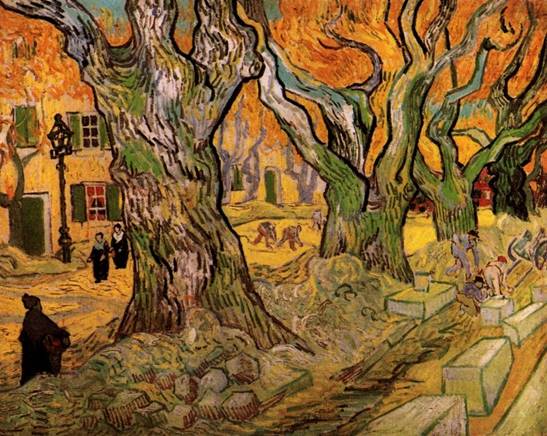
I had the good fortune to visit The Phillips Collection in Washington, D.C. two days ago. The Road Menders (above) is in their permanent collection. It is also one of the paintings used to illustrate my children’s book, Vincent, Theo and the Fox.
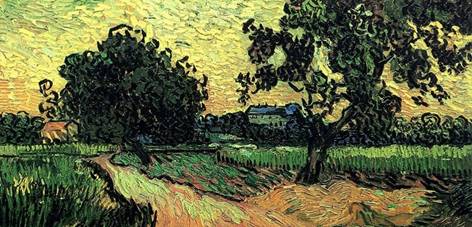
There are two versions of the painting: the one in the Phillips Collection and another (below), titled The Large Plane Trees (Road Menders at Saint-Remy), held in the Cleveland Museum of Art. 
In 2013, the Phillips Collection brought the two paintings together for Van Gogh Repetitions, an exhibition that included 13 examples of van Gogh’s penchant to sometimes re-do his paintings.
Art teachers in prior centuries believed that making copies of artworks was a valuable practice in learning art. Later, the idea of copying fell into disfavor in some circles. It was felt that an artistic genius should capture and express the original; should make an “authentic” representation or gesture of the subject; not focus on the mundane practice of, eww!, copying. Besides, the thought went, while an original is “imaginative,” a copy borders on being a fake–and a copy can come dangerously close to plagiarism.
Van Gogh’s repetitions, therefore, did not receive serious comparative study for some years. The exhibition at the Phillips Collection used modern techniques, like x-ray analysis, to establish that the version held by the Cleveland Museum came first (for example, x-rays show erasures and changes underneath the top-level paint in The Large Plane Trees; these are not present in The Road Menders). Visual analysis shows that the version held by the Phillips Collection features smoother brush strokes. There’s more. Henry Adams, in an excellent New York Times article, Seeing Double: Van Gogh the Tweaker, interviewed one of the exhibition’s curators, William Robinson. While the two paintings are very similar, Robinson points out that in The Road Menders van Gogh moved the street lamp for artistic effect, added more lines to the trees, and included an extra person digging. You can find other differences between the two images if you examine them closely, above.
Why did van Gogh “copy” his paintings? In a letter to his brother, Theo, van Gogh said that the repetitions were an opportunity to improve and clarify. Adams’ Seeing Double article further explains that, when working outdoors, van Gogh would be beset by gawking onlookers and the light would change. It was in the studio, van Gogh told Theo, that “he could transform a painting from a direct transcription of a scene into a true work of the imagination.” Take that, anti-copy purists!
Repetition is also modern. Using these two paintings, Michael Lobel, a professor of art history at Purchase College, S.U.N.Y., addressed van Gogh’s “contemporaneity” in an article in the May 2014 issue of Art in America magazine. Van Gogh remains relevant to the modern art world, he says, because his embrace of repetition lets us perceive him:
as an artist who understood the modern condition of the image as repeating and repeatable and subject to extensive circulation in the form of reproductions….this version of van Gogh is more compatible with the artistic outlook of our own time, in which the strategy of appropriation has become a central device in the artist’s toolkit.
Barbara J. King, Chancellor Professor of Anthropology at the College of William and Mary, makes an additional observation. In her NPR Cosmos & Culture blog, Van Gogh Teaches Us How To Keep Life Interesting, she points out that copying as a way to perfect artistic technique is not unusual (musicians, for example, practice many hours every day). King’s insight is that van Gogh’s repetitions are not about copying or practicing in any conventional sense. Instead, she points out that van Gogh’s repetitions are about looking at one’s finished, visible-to-the-public product and deciding to do it again, almost the same, but not quite.
I agree with King. Creative repetition gives incredible freedom and growth. Live concerts are exciting because each performance is slightly different. Rather than getting caught up in perfectionism, in worrying about whether one’s so-called finished product is good or bad, we would do well to heed King’s NPR blog post. She highlights the lesson van Gogh teaches us with his repetitions: “embrace and take delight in an iterative process…you can appreciate what happens when a new mosaic of meaning emerges from the previous one.” As ’70s rock band Steely Dan sings and (for fellow jazz lovers) the more recent Philipe Saisse Trio plays, Do It Again.
– Ted Macaluso
How is The Road Menders used in Vincent, Theo and the Fox? The book is an adventure story that introduces children 4 – 8 to van Gogh’s paintings in a fun, exciting way. The tale starts with young Vincent and Theo trying to catch a fox. After the young boys have finished chasing the animal, they reflect on how the fox tried and failed at different activities before finding happiness. Vincent thinks he too will try different things as he grows up. One is to be a road mender. Today’s painting illustrates that thought. If you haven’t seen the book yet, you can check it out here.
© 2016 by Ted Macaluso. May be freely reproduced provided you include attribution back to http://www.tedmacaluso.com.






 Van Gogh mentioned today’s painting in a
  from the bleakness of The Old Tower. Interestingly, in his famous painting of The Starry Night, the church is dark and silent even though the houses in town are warm and lit (the spire is also needle-sharp, touching a dark patch in the sky, and stands in contrast to the cyprus, with its living curves touching three stars).


 n Gogh was living in Auvers-sur-Oise he stayed at the Auberge Ravoux, an







 Also unlike his other restaurant paintings, today’s painting is dominated by dots. Van Gogh was experimenting with the artistic style known as
  or preschool and kindergarten kids. Whether you are dining in a fine French restaurant or eating at your school cafeteria, good nutrition is important. The USDA eBooks are free, kids can read the words themselves or press a button for the book to read the words to them, there is an interactive “plan your meal” page, and a maze where children have to touch the right nutritional foods to make it through to the other side. Before turning to writing, I worked for many years in the child nutrition/hunger field and some of my former colleagues created these eBooks. I’m very happy to see that they are now available. Your kids may be happy to see them too. Did I say they were free?
 Copeland, of course, is already famous in her own right (see the 2015 documentary,

 Georgia O’Keefe followed a unique, sometimes controversial, path to becoming one of America’s greatest painters. Her relationship with the famous photographer Alfred Stieglitz is, perhaps, too complicated for young readers. Two picture books, however, do a good job of showing how Georgia saw the world and what motivated her to follow her own path. Originally published in 1998,
 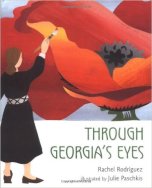 the Year and made the New York Public Library’s “100 Titles for Reading and Sharing.”
  rate from the shadow of her husband and mentor, Diego Rivera. The book shows Frida and Diego exploring the city. How familiar is this: he expresses an opinion; Frida disagrees? When the couple explore towering redwood groves Diego feels empowered; Frida falls asleep. Gradually, she explores the city on her own, focusing on the things that appeal to her. There is a great illustration where, out of the blue, Frida starts to sing Mexican songs at a party to honor Diego. That night, she painted a picture that made her famous. It was a portrait of her and Diego. As in life, he was big and she was small. However, in the portrait, in a ribbon in the beak of a bird, she puts her name first. Unlike many other children’s books on Kahlo (which, overall, give more information about her life and art), Me, Frida recognizes the significance of this step. In the story it occurs in a context in which its meaning makes sense. Estupendo!


 Ted Macaluso - Author