Blog

Wheatfield With Crows

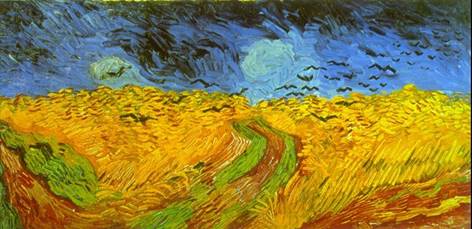
One of van Gogh’s most striking paintings, “Wheatfield with Crows,” was also one of his last. Observers have therefore analyzed and re-analyzed it for meaning. There are probably as many viewpoints as there are crows in the painting. Perhaps we should all just agree its beautiful.

image023

Because it was painted in the final month of his life, some wish to see Wheatfield With Crows as a lonely, suicide note. These interpretations focus on the dark sky, the allegedly ominous birds, the emptiness of the field, and the fact that the path goes nowhere. Some observers believe it matters whether the crows are flying towards the viewer or away. Still others think there is a hidden image of a severed ear in the cloud (if you rotate the picture 130 degrees). Dark interpretations are bolstered by the 1956 movie about van Gogh, Lust for Life, which, for dramatic effect, falsely portrayed the painting as van Gogh’s last. It was not.

This all strikes me as silly. What we know is that the painting is in the Van Gogh Museum in Amsterdam. It is a double-square canvas, which contributes to its imposing width and presence. It is dramatic. For example, the three paths could be the shadow of a giant bird. The darkness in the sky could be descending. Or, the darkness could be lifting. One can focus on the golden light of the field and the pretty, deep blue of the sky. But, then again, one could focus on the feeling of stormy darkness. Like most great art, the painting provides an infinite opportunity for viewers to draw forth their own meanings. Vincent’s letters do not clarify the issue. He wrote that he had made a point of expressing sadness, later adding “extreme loneliness” (de la solitude extrême), but also says he believes the canvases show what he considers healthy and fortifying about the countryside (and adds that he intended to take them to Paris as soon as possible).

The painting itself is in balance. The paths divide the canvas in 3 with 2 golden sections. The field occupies two-thirds of the canvass, the sky one-third. The colors–blue, golden yellow, green, brown–are complementary. Whether the viewer wishes to see the painting as “half full or half empty,” as impending darkness or impending light, the image is poised at the edge of change, at the moment just before something happens.

Personally, I see the painting as hopeful, as the sky being ready to clear for a beautiful day. In Vincent, Theo and the Fox, for this painting, I wrote:

“As the day drew to a close, the fox walked through a golden field. Crows flew out of his way, slowly circling in the sky. ‘I’m happy here. This is where a fox should be,’ he thought.”

Do you side with the pessimists or with the fox? It’s up to you. But I would love to know what you think. Leave a comment and I will read and respond with interest.

– Ted Macaluso

If you are unfamiliar with my book, Vincent, Theo and the Fox, it is a children’s picture book that weaves an adventure story around van Gogh’s paintings. While intended for children, adults find the book interesting too: it has full-color reproductions of over 30 of van Gogh’s masterpieces and the story gives readers new contexts for appreciating their favorite paintings. See the book here.

And finally, if you want to have some fun, enter wheat field with crows YouTube into your browser. One poster animates the crows flying toward you, another shows how to paint a copy by numbers, several pair the painting with good (and sometimes not so good) music. If only, van Gogh had known.

© 2016 by Ted Macaluso. May be freely reproduced, provided attribution and a link back to tedmacaluso.com is included.

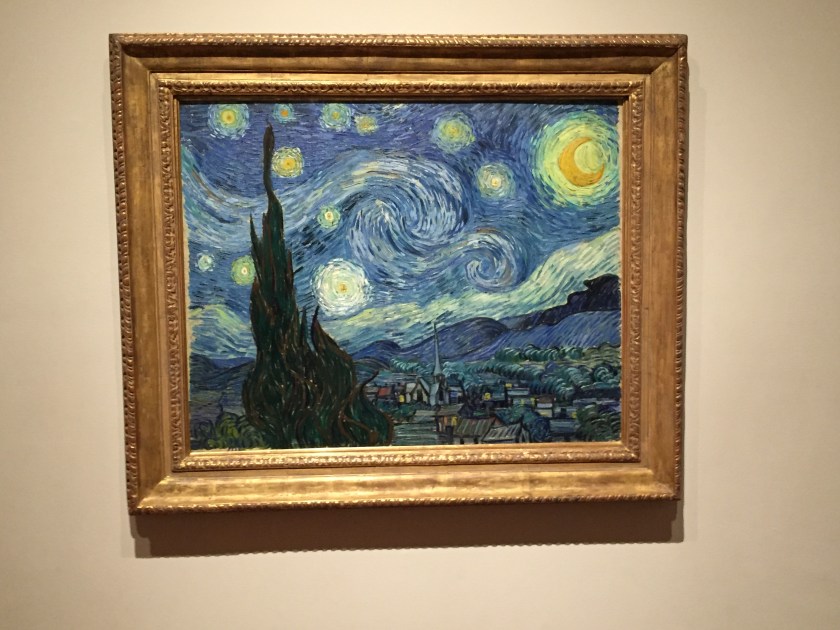
 

Starry Night in person

What happens when you see a masterpiece in person? For me, The Starry Night went from an iconic image in popular culture, to something that is real, personal, and deeply moving. It also left me with a question.

Going to museums is special. I had the good fortune to visit New York City this weekend and see The Starry Night at the Museum of Modern Art. The Museum allows non-flash photos, so here is my photo of it hanging on their wall.

IMG_1611

One does not usually see the frame in reproductions of the The Starry Night. This may sound crazy, but it was seeing the frame that made me realize the painting is, in fact, a real object, not merely a meme floating through popular culture. In my mind I always knew it was real, but seeing it in person made it feel real in a deeper way.

When I saw it “live,” the painting was smaller than I thought it would be. This is a picture I took over someone’s head (it was very crowded) that gives some sense of its size.

IMG_1603

One of the nice things about seeing the painting in person was that I could focus on different parts of the painting. For example, although the sky and stars dominate the image, the town is really quite beautiful.

IMG_1607

Looking at the town, the buildings are flat and, in comparison to the hills and sky, stable. I was struck by how the hills and trees, in comparison, were flowing like waves (very much like the light of the sky).

Focusing on the cyprus tree, it also flows. Most importantly, the tree sparkles like the stars, reaching and flowing towards them. The tree touches three stars: both the white and green ones in the image below and (if you scroll back up to the full picture), the yellow one just above the flowing cloud.

IMG_1610

Many interpret cyprus trees as symbolic of death. If so, the cyprus in The Starry Night seemed to represent a harmonious “death,” one that flows with passion and connects the earth and the stars. I felt peaceful seeing the painting. Everything is united.

Finally, the paanimal?inting left me with a question. Is that an animal in the very lower left of the image, above, (and blown up to the left)? It might be. At the very end of Vincent, Theo and the Fox I wrote, “Vincent smiled. In his dream, he saw the fox was happy, running through fields and hills, wild and free under the starry sky.” Could that mischievious creature have come back down into town?

What do you think? I would love to know and will read and respond to your comments with interest.

– Ted Macaluso

If you are unfamiliar with my book, Vincent, Theo and the Fox, it is a children’s picture book/early reader that weaves an adventure story around van Gogh’s paintings.  See it here.


© 2016 by Ted Macaluso. May be freely reproduced, provided attribution and a link back to tedmacaluso.com is included.

View of Roofs and Backs of Houses

How did van Gogh become van Gogh? The two years, from 1886 to 1888, which he spent living with his brother among the rooftops of Paris, marked his transition from somber dark to expressive color.

image016

On Mondays I write about one of the 30+ Vincent van Gogh paintings that illustrate the  book, Vincent, Theo and the Fox. Today’s painting, of the roofs of Paris, is important because it is among this landscape of zinc and slate that van Gogh’s artistic vision was transformed. Before arriving in Paris, his paintings were dark, steeped in the tradition of Dutch painters. Two years later, when he left Paris for the south of France, he was ready to master the explosive expressions of color that we see in many of his most beloved paintings.

With no advance warning, in February 1886, Vincent showed up at the door of his brother’s apartment in Paris, asking to move in. Vincent was broke; he had arrived from  Antwerp, Belgium where he was unable to pay his rent. Not surprisingly, the next two years were one of the very few times when Vincent and his brother Theo struggled to get along. However, the move was a good one for van Gogh’s artistic development.

Theo van Gogh, Vincent’s younger brother, lived in Montmartre, the artistic center of Paris. Two years earlier, in 1884, he had been promoted to work in the Paris headquarters of Goupil & Cie, at the time the leading art dealer in France. As Nina Siegal explains in her New York Times article, Becoming Vincent Van Gogh: The Paris Years, van Gogh “was immediately thrust into a milieu of young avant-garde artists experimenting with new styles.” Siegal explains more about the Parisian art scene in those years:

“Impressionists…were busy with their explorations of light and shadows. The Pointillists…were separating out colors into individual dots dabbed on canvas to form discernable figures. The Cloisonnists, meanwhile, were painting with bold and flat forms separated by dark outlines. Vincent…tried his hand at all of [these styles].”

Exposed to these influences, Vincent re-examined his ideas of painting. He met many of the notable Parisian painters during this period too, further inspiring his artistic growth. Read more in Siegal’s excellent and knowledgable piece, here.

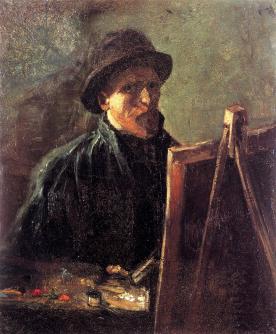
From the start of van Gogh’s years in Paris to its end, the transition in his art is remarkable. For me, the two self-portraits below say it all. The one on the left is from 1886, just after he moved to Paris; the one on the right is from 1888, just before he left Paris and moved to Arles.

self-portrait-with-dark-felt-hat-at-the-easel-1886(1).jpg!HD  image030

Wow! I like both paintings. But it is the Vincent on the right who was ready to create such masterpieces as his sunflowers, wheat fields, and Starry Night!

(Many scholars have written about van Gogh’s Paris years. If interested, check out Van Gogh: The Life, a phenomenal book, or Becoming Van Gogh, a shorter piece in the New York Review of Books that displays images of his pre-Paris sketches and his post-Paris work. Van Gogh created 224 paintings in Paris, including a number of scenes of rooftops. You can find the complete list of them on vggallery.com, here.)

Finally, back to the roofs of Paris. Many artists, not just van Gogh, have been inspired by them. The Paris City Council is now asking UNESCO to designate their “unique” roofs a world heritage site. What do you think about the roof request? About van Gogh? About books intended to inspire children’s appreciation of great art? I would love to know and will read and respond to your comments with interest.

Ted Macaluso

If you are unfamiliar with my book, Vincent, Theo and the Fox, it is a children’s picture book/early reader that weaves an adventure story around van Gogh’s paintings. See it here.

© 2016 by Ted Macaluso. May be freely reproduced, provided attribution and a link back to tedmacaluso.com is included.


A Pair of Shoes

What did van Gogh mean to convey with these shoes? Three philosophers debate what the painting means for the theory of art; other commentators see the shoes as spiritual; yet others, as symbolic of Vincent’s life.

image017

Vincent, Theo and the Fox weaves a story around 30 of van Gogh’s paintings. Readers also want information about each painting. Every Monday I write about one of the paintings. Why did I choose this painting this week? My house in the Washington, D.C. suburbs got 28″ of snow during the Blizzard of 2016. After shoveling through 4 – 5 foot drifts, my boots felt just like van Gogh’s painting!

Experts disagree on when and where Van Gogh painted A Pair of Shoes (some say Paris, 1886, others Nuenen, 1885). Either way, in Philosophers Rumble Over Van Gogh’s Shoes, Scott Horton argues that the shoes became a celebrated painting because philosophers disagreed about its meaning. In 1930, the philosopher, Martin Heidegger, saw the painting at an exhibition and, years later, used them in his essay, The Origin of the Work of Art.

Heidegger wanted to make the case that it is only what one perceives from a painting that matters for art theory. And Heidegger perceived a lot in these shoes: “From the dark opening of the worn insides of the shoes the toilsome tread of the worker stares forth. In the stiffly rugged heaviness of the shoes there is the accumulated tenacity of her slow trudge through the far-spreading and ever-uniform furrows of the field swept by a raw wind.” Heidegger attributes many layers of significance to the shoes: loneliness, anxiety about the source of her next meal, joy at surviving want, the “trembling” before impending childbirth and “shivering at the surrounding menace of death.” Ultimately, the shoes are “protected in the world of the peasant woman.”

But wait! in a 1968 essay, The Still Life as a Personal Object, philosopher Meyer Schapiro pointed out that Heidegger messed up: they are not women’s shoes and the painting is not addressing the world of the peasant woman. There is strong evidence that these were van Gogh’s own shoes, which he bought in a flea market and wore “on an extended rainy walk to create the effect he wished for this painting.” Shapiro argued you cannot just look at the physicality of a painting, like Heidegger proposed; you have to recognize that the artist is present in a painting, especially a still life. In short, Schapiro believes van Gogh is telling us about his own hard life in A Pair of Shoes.

The third philosopher to join the fray, Jacques Derrida, believes both Heidegger and Shapiro are wrong. The philosophical differences among the three scholars gets very complicated: to read more, go to art historian Dayna L.C.’s excellent article, Interpreting a Painting of Shoes.

A Pair of Shoes is certainly widely discussed. In addition to the philosophical debate, in Interpretations of Vincent Van Gogh’s A Pair of Shoes the website Spirituality & Practice says, “To be spiritual is…to see the fingerprints of the Divine in the most ordinary objects and things. We see that touch in A Pair of Shoes, and we are grateful to Van Gogh for opening our eyes to these humble companions which we usually take for granted. The artist conveys the sanctity of the shoes and as a result, we are compelled to reframe our view of them. Thank you, Vincent, for helping us to love as many things as we can.”

One wonders what van Gogh would think about the philosophical debate over, and spiritual interpretations of, his painting? What does the painting mean to you? I would love your comments and will read them with great interest.

Ted Macaluso

A Pair of Shoes appears halfway through the book, when Vincent and Theo are feeling frustrated from chasing the fox (don’t worry, they all get a second wind, which is when they learn about growing up). If you haven’t yet read Vincent, Theo and the Fox, check it out here.

© 2016 by Ted Macaluso.May be freely reproduced, provided attribution and a link back to tedmacaluso.com is included.

Vincent’s Bedroom

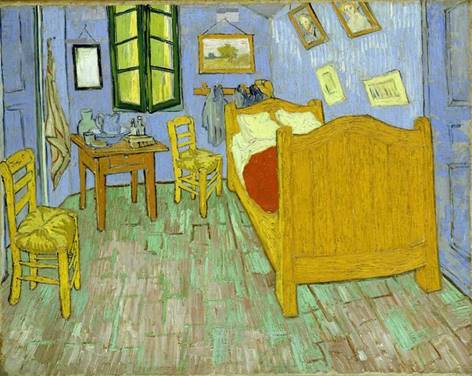
Vincent van Gogh’s colorful bedroom is probably one of the most famous bedrooms in art. Did you know that there is not just one painting, but three? The Art Institute of Chicago tells us why.

Vincent, Theo and the Fox weaves a story around 31 of van Gogh’s paintings. Readers also want information about each painting. Every Monday we post about one painting in the book. Todays painting is Vincent’s bedroom in Arles.

image019

Vincent van Gogh loved the painting so much he actually made three versions. The Art Institute of Chicago has an upcoming exhibition that will bring all three versions together for the first time. The exhibition will run from February 14 to May 8 0f 2016. Using digital technology, it will show the subtle differences between the three paintings. The exhibition promises to explain the significance of the three paintings and how they relate to an important theme in van Gogh’s work, the idea of home.

This exhibition is the first to truly delve into the fascinating history of these three paintings. Beginning with Van Gogh’s early canvases of cottages and birds’ nests, the show explores the artist’s use of the motif of home—as haven, creative chamber, and physical reality—and follows the evolution of this theme throughout his career… Source: Art Institute Chicago: Member Magazine, January/February 2016, p. 13

You can find out more on the Art Institute’s website. The Art Institute is one of the world’s great museums. Go if you can. (A big thanks to Duke Ryan, author of Amanda’s Autobiography, for telling me about the exhibit.)

Finally, whether or not you can go to the exhibition, check out this intriguing video from mjkooopman about Vincent’s bedroom:

And why are there three paintings of his room? According to the Art Institute, water damage threatened the stability of the original painting. About a year later, therefore, van Gogh made a second full-size painting of his room so that he could ensure that the image would be perserved. A few weeks after that, he made a smaller, third painting as a gift for his mother and sister. Van Gogh’s artistic investment in the image of his room in Arles gives credence to the Art Institute’s interpretation that the three paintings exemplify van Gogh’s “relentless pursuit of home.”

The painting of Vincent’s bedroom appears about halfway through the story of Vincent, Theo and the Fox. If you haven’t yet read the book, you can check it out here.

text © 2016 by Ted Macaluso


;

Starry Night

The book weaves a story around van Gogh’s paintings. Readers also want information about the paintings. Every Monday we post about one painting in the book.

Kids (and parents) who read Vincent, Theo and the Fox often want to learn more about each of the 30+ paintings in it. So every Monday I’m posting interesting information about one of the book’s paintings. Here is educator Natalya St. Clair’s fascinating explanation of the math behind Starry Night. The video is animated by Avi Ofer.

Enjoy!


text © 2016 by Ted Macaluso

The story behind the story

Readers sometimes ask how I wrote Vincent, Theo and the Fox; how did you come up with the idea? This is the story behind the story.

To get my son to go on exercise walks with me I would tell him stories. They were simple action tales: Suddenly, a monster…Bam, a hero…Wham another monster. And then one day a real monster struck: Mark got very sick. He had a series of lung infections and several times a day had to sit still for twenty minutes breathing through a nebulizer. Not what an active 5 year old boy wants to do! Just before one of these episodes his grandmother was visiting and we had all gone to the National Gallery of Art to see an exhibit of van Gogh’s paintings. She bought the exhibit catalog, Van Gogh’s Van Goghs:  Masterpieces from the Van Gogh Museum Amsterdam by Richard Kendall with contributions by John Leighton and Sjraar van Heugten. One afternoon when Mark was being nebulized, he asked me to tell a story. I did not have it in me. He pointed to the catalog saying, “Read me the story.” I tried to explain, “It’s not a story.” Neither he nor Grandma would let me off easy. I had to “read” the catalog to him.

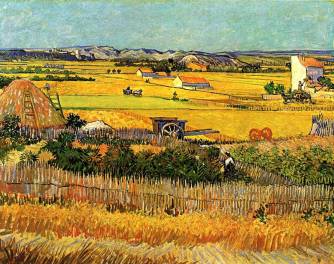
What to do? An art catalog is not a wham, bam action tale. I opened it at random and it showed Harvest at La Crau, with Montmajour iimage001n the Background (Arles, June, 1888). I thought to myself, “OK, Vincent has to be a boy to make this interesting…but what is he doing?” I surprised myself by saying, “One day, when he was a boy, Vincent van Gogh and his brother, Theo, were looking at the harvest when they saw a fox sneak into the cart.” That picture and that idea became the start of Vincent, Theo and the Fox. Vincent and Theo chased the fox through a bunch of van Gogh’s paintings until the nebulizer was done. At that point, the fox got away and the boys went home.
The tale kept Mark engaged but it was not really a story yet. When I decided to turn it into a real story I knew it needed more. I asked myself, “What do boys do?” The answer, of course, is that they grow up.  And while they grow up they wonder what they will become. We all know that van Gogh became a painter, but he didn’t go there directly, trying a number of different jobs first. So as a boy in a story there is wonder and mystery when Vincent thinks about growing up. Somehow I came up with the idea that the fox was young too—he was also trying to grow up and find his way in the world. And that, I believe, is what makes Vincent, Theo and the Fox a delightful tale. We have two boys and a fox thinking about growing up and through their actions teaching each other about life. The writer, Susan Sontag, writes that “art is not only about something, it is something.” By this, she means that art isn’t like science or history, it doesn’t teach you facts you should know. Rather, literature gives readers an experience from which they learn and take their own lessons. I like to think that Vincent, Theo and the Fox achieves this: it does not teach about growing up, it lets readers learn about it.

Because the art is beautiful and chase tales are exciting, readers don’t “get” what they are experiencing until it is over. But my hope is that the story stays with children and they learn while they process the experience of the story. Because the book gives a brief biography of van Gogh in an epilogue, children learn about van Gogh while processing the experience of the story. I think this really engages them in van Gogh’s art and gives the story more depth.

What do you think about the story? What do your children get from it? If you want to leave comments I will read them with interest.

Thanks, Ted Macaluso

© 2016 – 2019 by Ted Macaluso.

For teachers: classroom materials

Reading the book is just the start…tie it in to actual lesson plans for maximum effect.

Our Pinterest board includes links to classroom materials, videos and lesson plans that pair well with Vincent, Theo and the Fox.

Picture for Pinterest classroom materials

Kids Books On Vincent van Gogh

Thanks so much for considering Vincent, Theo and the Fox Some other books about van Gogh are the following:

Vincent’s Colors. This gem of a book was written by van Gogh (through his letters to his brother) and the Metropolitan Museum of Art. The hardbound book introduces young (and old) readers to the colors of the rainbow by showing the artist’s words and paintings together.

Camille and the Sunflowers was published in 1994 but still enchants readers today. Laurence Anholt wrote and illustrated this story based on a true-life incident. See also van Gogh and the Sunflowers (Anholt’s Artists Books For Children) by the same author.


Visiting Vincent Van Gogh displays  some of the artists paintings and discusses how they reveal his life and emotions.

Katie and the Starry Night by author/illustrator James Mayhew is a classic. What’s Katie to do when she reaches into a painting and all the stars tumble out?

Vincent Van Gogh: Sunflowers and Swirly Stars by author/illustrator Joan Holub is part of the Smart About Art series. A fictional “Brad” writes a report about the artist.

Children’s Educational Book: Junior Vincent van Gogh: A Kid’s Introduction to the Artist and his Paintings by Fiona Holt is part of the “Smart Reads for Kids” series.

In the Garden with Van Gogh is a board book by Julie Merberg and Suzanne Bober.

What’s So Great About Van Gogh?: A Guide to Vincent Van Gogh Just For Kids! I have not read this book by Max Tanner. The book is intended to show children why van Gogh was so important for the world.

Vincent Van Gogh’s Cat is an art project written and illustrated by  Indiana Second Grade Students of East Washington Academy in Muncie

Twenty-Four Vincent van Gogh’s Paintings (Collection) for Kids by Stanley Cesar has mixed reviews on Amazon since there are no explanations for kids despite the title.

Parental warning – the books below include discussion of when van Gogh cut off his ear. Probably not for very young children.

Vincent Van Gogh: Portrait of an Artist by Jan Greenberg and Sandra Jordan was named a Robert F. Sibert Honor Book by the American Library Association. Ages 10 and up.

Vincent van Gogh – A Short Biography for Kids by Josephine Madden. This Kindle-only book is 14 pages.

Van Gogh (Getting to Know the World’s Greatest Artists) by Mike Venetia is part of a series.

Vincent Van Gogh (Art Profiles for Kids). Jim Whiting’s book is for ages 10 and up. It traces how van Gogh was tormented but continued to paint to express his feelings.


Happy Reading!

© 2016 by Ted Macaluso